Not a generic "salon" bot with your prices typed into a form. Romy is built for hair and nothing else. She knows a balayage is not a bang trim, that highlights change length by hair density, which stylist is right for thick curly hair, and what to do when someone is twenty minutes late. We build her, connect her to your booking system, and run her every month. Your hands stay full. Hers don't.
Prefer to talk to a human first? Book a free 30-minute call →
of inbound calls go unanswered at the average small business when staff are busy. In a salon, staff are always busy.
of clients book with whichever business responds to them first. Not the best one. The first one.
of inbound volume lands after hours, when every chair is empty and nobody picks up.
a year for one full-time front desk in Canada. One person, one shift, and they still go home at six.
Romy is live on a real line running a demo hair salon. Ask what a full head of foils costs. Ask who is good with curly hair. Tell her you are running late. Ask her in Portuguese. Try to trip her up, then ask for a human and watch her hand you off.
She answers on the first ring, at midnight, on a Sunday, and during your busiest Saturday. This is the same build your salon would get, just trained on a fictional one.
No phone needed. Your browser asks for microphone access, then you are straight into a live conversation with the same assistant. The transcript appears as you speak. Try switching language mid-sentence.
Every AI can read a calendar. The reason a hair client trusts her is that she handles the parts that are specific to hair: what the service actually is, how long it actually takes, who should actually do it, what happens when the day slips, and when they should be back. This is the whole difference.
She can tell a bang trim from a full colour correction and books them completely differently. Simple trims and standard cuts go straight into the chair. Colour correction, balayage, extensions, curly cuts and full transformations get routed into a consultation first, with the right stylist and the right block of time. Where your salon supports it, she texts a secure link so the client can send inspiration and current-hair photos before they come in, tagged to the booking so the stylist opens the day already knowing what is walking through the door.
"Highlights" is not a duration. She asks the two or three questions that actually change the block: length, density, how much previous colour is in it, when it was last done, whether there are extensions to remove. Then she adds the pieces your booking software forgets on its own — consultation time, toner, the wash and blow-dry, processing gaps, removal time. The result is a day that runs on time instead of a two-thirty that eats the four o'clock and a stylist eating lunch at seven.
"Who is best with thick curly hair?" "Who does blonde transformations?" "I want a barber who is actually good at fades and beard shaping." She matches on specialty and on level, not simply on who has a gap. She knows which stylist your regulars usually see, so nobody gets quietly moved to a new chair. When the specialist is booked out, she says so plainly and offers the next person who can genuinely do that work, with the price for that level.
"I am twenty minutes away and my appointment was at two." Most front desks either cancel or say yes to something the stylist cannot deliver. Romy does neither. She checks what actually still fits in the time that is left, offers a shorter or partial service where your rules allow it, asks your stylist or front desk when the call is genuinely yours to make, and books the next real opening when it is not. The chair keeps earning and the client keeps the relationship instead of a fine and a bad taste.
Rebooking is where hair revenue actually lives, and it is the first thing that slips when the desk is busy. She does not send a generic "time for a visit" text. She prompts on the rhythm of the service they had: fades every two to three weeks, root touch-ups on your colour interval, gloss and toner refreshes between full colours, extension maintenance before it becomes a repair, curly cuts on their own schedule. She reaches out at the right moment, and she books it on the call rather than leaving a link to be ignored.
Your neighbourhood does not speak one language. Your front desk does. Romy answers in whatever the caller opens with and switches mid-conversation when they do — Portuguese, Spanish, Mandarin, Cantonese, Punjabi, Arabic, French, Tagalog, Russian, Farsi, Korean, Vietnamese, Italian, Polish, Hindi, Ukrainian and dozens more. Same prices, same policies, same booking, no interpreter and no "sorry, could you repeat that?". The booking, the notes and your monthly report come back to you in English.
In most cities, a real share of the people walking past your salon would rather book in their first language. Today they either struggle through it or they hang up and find a salon where someone speaks it. Romy removes that entirely. She detects the language on the first sentence, answers in it, and keeps your pricing and your policies exactly the same in every one of them.
A barbershop and a blonde-specialist colour studio have almost nothing in common at the front desk. Different questions, different timings, different rebooking rhythm, different price logic. Pick yours and see what she already knows before we start.
If your clients book a chair and somebody has to answer the phone to make it happen, Romy fits. Not sure where you land? It takes one call to find out.
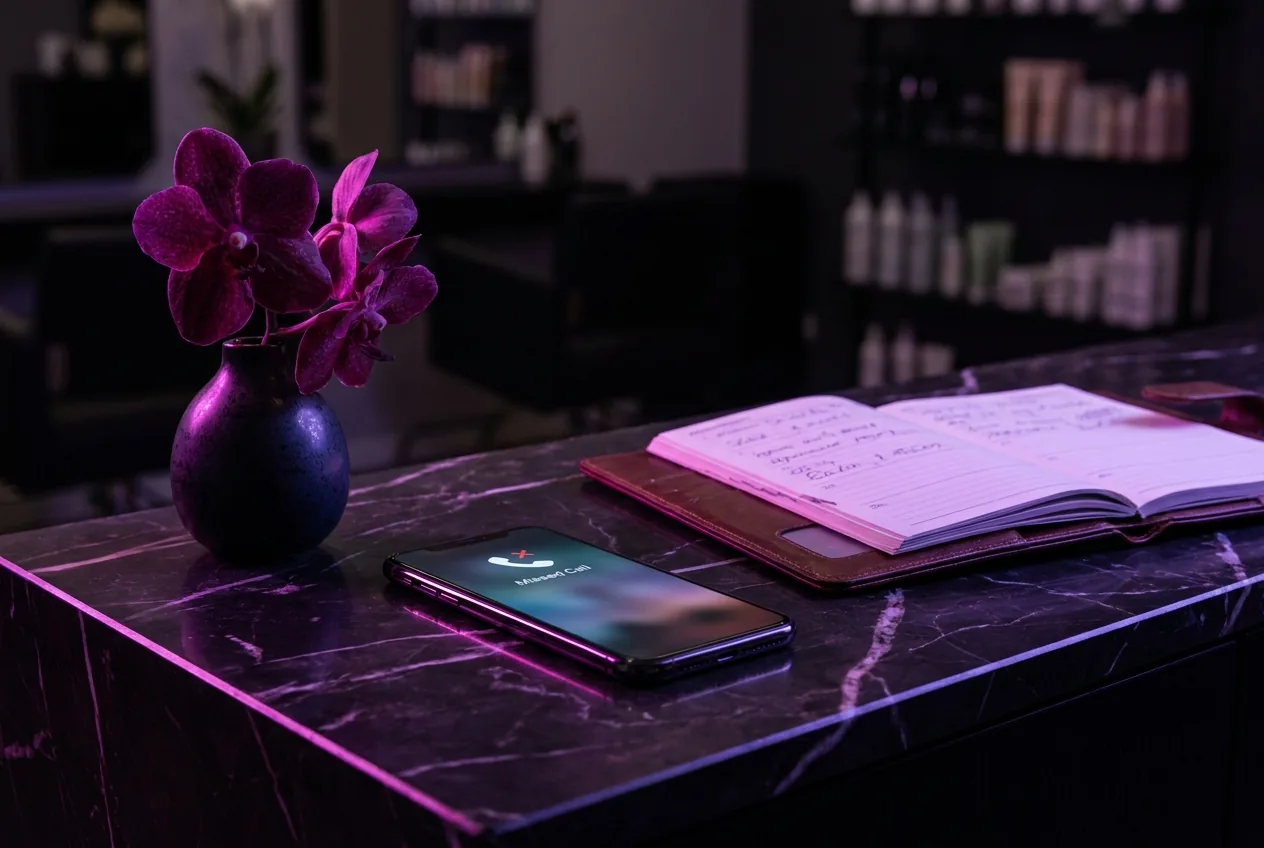
In most salons the owner is booking, running the floor and standing behind a chair with their hands in someone's hair. The phone rings anyway. Somebody who wanted a three-hundred-dollar balayage hears four rings and a voicemail beep, and books at the place down the street that picked up. Nobody logs it. It just quietly happens every week, and it never appears on a single report.
You cannot stop mid-foil to answer. Most callers never leave a voicemail. They dial the next salon on the map and you never know they existed.
Clients scroll Instagram and call after work and on Sundays, exactly when your salon is closed and the phone goes dark.
How much for highlights, how long does balayage take, do you do curly hair, do you take walk-ins, where do I park. All day, instead of working.
Someone books "a trim" and arrives wanting box-dye removal. Now the whole afternoon slides, the four o'clock waits, and everybody eats it.
Prices by stylist level, add-on toner, long-hair surcharges. Whoever picks up guesses, and the client arrives expecting a number nobody meant.
Thirty-five to forty-five thousand a year for one person on one shift, who still is not there at 9 PM on a Sunday when the colour booking comes in.
They are not booking with the best colourist, the closest salon, or the one with the nicest feed. They are booking with whoever picks up and gives them a straight answer. Every minute you take to call back is a minute someone else is closing them.
Swipe the chart →
Directional, not a measured statistic. The shape is the point, and every salon owner already knows it is true.
Romy picks up on the first ring, quotes the service by stylist level, and books it. The client never dials anyone else.
You spot the missed call between clients and ring back. Sometimes you catch them. Often you get voicemail, because they are on the phone with the next salon.
They have spoken to two other places. You are now the third quote, and the third quote is a price comparison, not a booking.
They are booked, and they will post the result from someone else's chair. You will never know they called.
Web forms and Instagram DMs are where hair bookings go to die. They sit unanswered until someone has a free minute, which in a salon is never. Romy calls the moment the form lands, while they are still on your site with their phone in their hand, qualifies the service, and books them before they open the next tab.
A real hair request, the way people actually talk. Not a menu, not a form, not "press one for bookings".
"I want balayage next week, preferably after five, but I need someone good with thick dark hair."
Asks only what changes the booking: length, density, previous colour, when it was last done. Gives your approved price range instead of false certainty. Matches a stylist on specialty, then holds the right amount of chair time for that hair rather than a generic slot.
Takes the deposit on long colour, explains the cancellation policy in your words, distinguishes a reschedule from a cancellation, and sends the confirmation before they hang up.
Requests an inspiration photo through a secure link and tags it to the booking. Sends your prep instructions so the client arrives ready and the appointment actually runs on time.
Not a phone tree, and not a separate website chatbot quoting different prices. One agent, one knowledge base, writing into the booking system you already run.
One call. Your service menu, your prices by stylist level, your real timings, who specialises in what, and your rules on deposits and walk-ins.
We train Romy on your hair menu and wire her into your booking system. Nothing for you to configure, no dashboard to learn.
We run test calls with your real client questions, in the languages your clients use. You hear her voice and sign off before she touches your line.
24/7 monitoring, a monthly report of what she booked, and improvements included inside your retainer.
Two numbers. The sliders start at typical figures for colour salons, so move them to yours. Most owners have never actually done this maths, which is exactly why the number is what it is.
Every call nobody picked up: after hours, mid-colour, on a Saturday, during the school run.
Not one visit. A colour client at six-week intervals plus product is rarely under a thousand.
One in four is deliberately conservative. These are your own inputs, not a claim about results. CAD.
This is the full list, not a teaser. Other vendors charge more for the useful parts, or leave them for you to configure. We build all of it into your Romy and tune it every month, at every price.
Every one of these is included at every price, switched on and tuned for your salon by us. There is no feature list to shop from and nothing to upgrade into.
Cheaper AI receptionists exist. The columns that matter are the middle two.
| Option | Who sets it up and fixes it | Knows hair specifically | Every language | Monthly |
|---|---|---|---|---|
| Voicemail | Nobody. It just takes a message | No | No | $0, and the client is gone |
| Another front-desk hire | You hire, train and cover them | Once they learn it | Whatever they happen to speak | $2,900–$3,750 |
| Human answering service | Them, from a generic script | No, they read from a card | Usually English only | $235–$1,275+ |
| Self-serve AI receptionist app | You do. Scripts, integrations, fixes | "Salons" as one category | Sometimes, if you configure it | $150–$400, plus your evenings |
| The AI inside your booking software | You do, and only if you stay on that platform | Generic to their whole customer base | Varies by platform | Bundled or add-on |
| Romy for Hair, by Lumora | We do. All of it, every month | Built only for hair and barbering | Yes, automatically | From $500 |
Swipe the table →
Market ranges in CAD, from Lumora's competitive analysis, August 2026.
You did. They are real and some are decent. Before you buy one, understand what the price difference actually is, because it is not the AI.
Software, and a login. You write the greeting. You type in every service, every stylist level, every add-on and every price. You set the escalation rules. You connect the booking system yourself. And when it books a full head of foils into a forty-five minute slot on a Saturday, you go hunting for the setting that did it, between clients.
One call, then we build her. We load your menu, your stylist levels and your real timings, wire her into your booking system, and test her against the questions your clients actually ask — in the languages they ask them in. She goes live only after you have heard her and said yes. Something wrong at 8 PM? You text us. We fix it.
Genuinely: if you enjoy setting up software and your evenings are free, buy it. It will work. We are built for owners whose evenings are already gone, who have never once wanted to open a dashboard, and who would rather pay someone to make the phone stop being their problem.
You are not choosing between two AI receptionists. You are choosing between software you have to run and a front desk we run for you.
Every other AI receptionist hands you a login and wishes you luck. We build Romy for your salon, launch her, watch her, and improve her every month. You never configure anything. Here is exactly what we commit to, in writing, before you spend anything.
We test her against your real client questions — the awkward ones included, in the languages your clients actually use — and you sit on that call. She does not touch your phone line until you have heard her voice, read her script and said yes to both. If she is not right, she does not go live. There is no version of this where you find out how she sounds from an angry regular.
You do not pay a retainer through the build. The clock starts on go-live. After any initial term it is month to month with simple notice, you keep your phone number, and you see the monthly report of what she actually booked before you see the invoice for the month after it. If she is not earning her keep, you will know from your own numbers first.
Colour price went up. New stylist started. Holiday hours. A new keratin service. Something she said clumsily on a Tuesday. You send us a text and we change her. No configuration screens, no ticket queue, no change fees, no per-request billing, no waiting for a release. That is not a support policy we tacked on. It is the entire product.
We would rather you tested her than read a quote you cannot verify. The number at the top of this page is live. Call it, push her, and judge us on what you actually hear.
Think of it the way a business thinks about managed IT. Nobody hires a person to run their email and phone systems; they pay a company to just handle it. Same idea. The AI is the cheap part, and anyone can rent a voice. What you are paying for is the build we do for your specific salon, the hair knowledge we already have so you do not have to explain your own trade, and the people who stay on it after launch instead of pointing you at a help centre.
A consultant pulls out your service menu, your prices by stylist level, your add-ons, your deposit rules, how long each service really blocks the chair, and who is genuinely good at what.
Your greeting, your tone, your escalation rules, your colour and consultation policies. She is scripted for your salon, not picked from a template list of three personalities.
We connect your booking system, map every service and every stylist, and prove a booking she makes lands exactly where it should. You never touch an API key.
We run your real questions at her, the awkward ones included, in the languages your clients use, and fix what she gets wrong. She goes live only after you have heard her and said yes.
24/7 monitoring. If she stops answering at 2 AM on a Saturday, that is our problem to catch and fix, not yours to discover on Monday morning.
Colour price went up. New stylist started. Someone left. Holiday hours. New keratin service. You send a message and we update her. No ticket queue, no change fee, no dashboard.
We read what she was actually asked, find where she was clumsy or too cautious, and improve her. She is better in month six than she was on the day she launched.
A plain report: calls answered, bookings made, languages spoken, what clients asked most, what we changed. Proof of value in writing, so you are never guessing.
A front desk hire costs $35,000 a year, works one shift, speaks one language, and eventually quits.
Romy costs a fraction of that, works every hour you are open and every hour you are not, and gets better every month instead of leaving.
You opened it to do hair. Somewhere along the way you became the receptionist, the scheduler, the person texting everyone back at 10 PM, and the only one who really knows what a full head of foils on long thick hair should cost. That is not a business. That is a job you built for yourself and cannot leave.
Romy takes the part that never needed you. The phone stops interrupting the chair. Sunday stops being admin. Your team stops guessing what to quote. And the colour bookings you were quietly losing every week start showing up in the calendar instead.
You built your expertise doing hair. That is your specialty. It is not your job to also become an AI expert. That part is ours.
Every plan includes the build, the integration, the monitoring, the monthly tuning and unlimited changes within your setup. Plans differ by call volume, how many systems we connect and how much of our time you need — never by features. Month to month after any initial term, and you keep your number.
Extra minutes $0.50 · minutes reset monthly · pay annually and save 10% · month to month after any initial term, and you keep your number.
There is no cheaper tier. A managed front desk done properly costs what it costs, and doing it badly is worse than not doing it at all.
Call the number at the top of this page and judge for yourself. Romy uses premium natural voices under 800ms with barge-in, so clients can interrupt and talk over her the way they would with a person. You choose and approve her voice, her greeting and her script before she ever touches your line.
She is built for hair specifically, which is the entire point of this page. She distinguishes a bang trim from a colour correction, knows that "highlights" is not one duration, asks about length, density and previous colour before holding a block, adds toner and blow-dry time automatically, and routes transformations into a consultation. That knowledge is ours before we start — it is not something we ask you to type into a form.
We ask you, on day one, and we ask properly: not "how long is a colour" but how long it really takes on short versus long hair, with and without a toner, when there is box dye to lift, when extensions need removing first. Those become her rules. If a stylist tells you three months in that balayage on long hair needs another thirty minutes, you text us and it changes that day.
Where your salon supports it, yes. She texts a secure link, the client uploads their inspiration and current-hair photos, and it is attached to the booking so the stylist sees it before the client sits down. This is the single biggest fix for colour appointments arriving with a very different plan than the one that was booked.
She triages instead of cancelling. She checks what will still fit in the time left, offers a shorter or partial service where your rules allow it, asks the stylist or front desk when the decision is genuinely theirs, and books the next real opening when nothing fits. You set the rules once and she applies them the same way every time, which is more than most front desks manage on a busy Saturday.
Effectively all of the ones your clients use: English, French, Portuguese, Spanish, Italian, Mandarin, Cantonese, Korean, Japanese, Vietnamese, Tagalog, Punjabi, Hindi, Urdu, Gujarati, Arabic, Farsi, Turkish, Hebrew, Russian, Ukrainian, Polish, Romanian, Greek, German, Dutch and more. She detects the language from the first sentence, answers in it, and switches mid-call if the caller does. Your transcripts, notes and reports always come back in English.
Square Appointments is what we are live on today. She reads real availability by service and by stylist, then writes the booking during the call. If you run something else, tell us which one and we will confirm what is possible before we promise you anything — and where an integration exists, we build it at the same price, with no integration surcharge. Some platforms are open and some are closed, and we would rather tell you the truth up front than sell you something and hand you a message-taker.
As little as 5 business days once we have your service menu, prices and access. A single-chair studio is usually 5 to 7 days, a busier salon 7 to 12, and a multi-location group 2 to 4 weeks. Billing starts on the day she goes live, not the day you sign.
She follows your rules and warm-transfers to you with the whole conversation attached, so you pick up already knowing what they want. She never guesses and never invents a price. She will not promise a colour result over the phone, and anything that sounds like scalp irritation, an allergic reaction or a complaint about previous work goes to a person immediately.
No. Keep them. She works alongside your front desk and takes the calls that do not need a person: hours, price ranges, straightforward bookings, reschedules, the same ten questions. Your team gets that time back for the clients in front of them. If a twenty-person bridal party calls, Romy should not be handling that, and she does not — it transfers to your person. You decide exactly where that line sits and we build it that way.
Two reasons. It only works while you stay on that platform, so the day you outgrow it or switch, your receptionist leaves with it. And it is built generically for that platform's entire customer base, from gyms to dog groomers, which is why it will not know that a fill-in on a colour correction is a different appointment from a root touch-up, or that your curly specialist cuts dry. Romy works with whatever you run, and she is built only for hair.
Because you never have to use this one. Most tools hand an owner a login and leave them to configure it, which is exactly why they end up unused. There is nothing here for you to set up, learn or maintain. We do the build and we do the changes. If you ever find yourself opening a dashboard, we have failed at our job.
We are a Toronto firm operating to PIPEDA-aware standards. We collect only what the booking needs, disclose AI use and call recording, store credentials securely, and never sell your data. You own it. Photo intake runs over a secure link with your retention rules applied.
Yes. Month to month after any initial term with simple notice, and you keep your phone number. If she is not booking, you will see it in your monthly report before you see it on your invoice.
Book a free 30-minute call. We will listen to how your bookings actually come in, recommend the right plan, and send your proposal within 48 hours. Sign, and we start building Romy for your salon.
Already a client? Refer a salon and earn a discount on your retainer.
Romy is built and run by Lumora Intelligence, an AI consulting firm in Toronto. Voice is where we start. Ask us what else we do.
 Romy
Romy